Fair-Scope. A freelance Calculator
A calm, premium freelance pricing calculator that helps designers stop undercharging by pricing scope instead of screens. Check Out - https://fair-scope-seven.vercel.app/
Category:
Product Design, Vibe Coding
Date:
The Problem Nobody Was Talking About
I kept seeing it in design communities. Someone would share their project, beautiful work, and then mention they charged ₹12,000 for it. A mobile app. Three months of their life. Comments would follow saying that was too low, and the designer would respond that they did not know what else to charge.
This was not a confidence problem. It was an information problem. Nobody had given these designers a way to think through what a project actually costs. So they counted screens, picked a number that felt reasonable, and quietly absorbed everything else.
I wanted to build something that changed that.
What the Tool Needed to Do
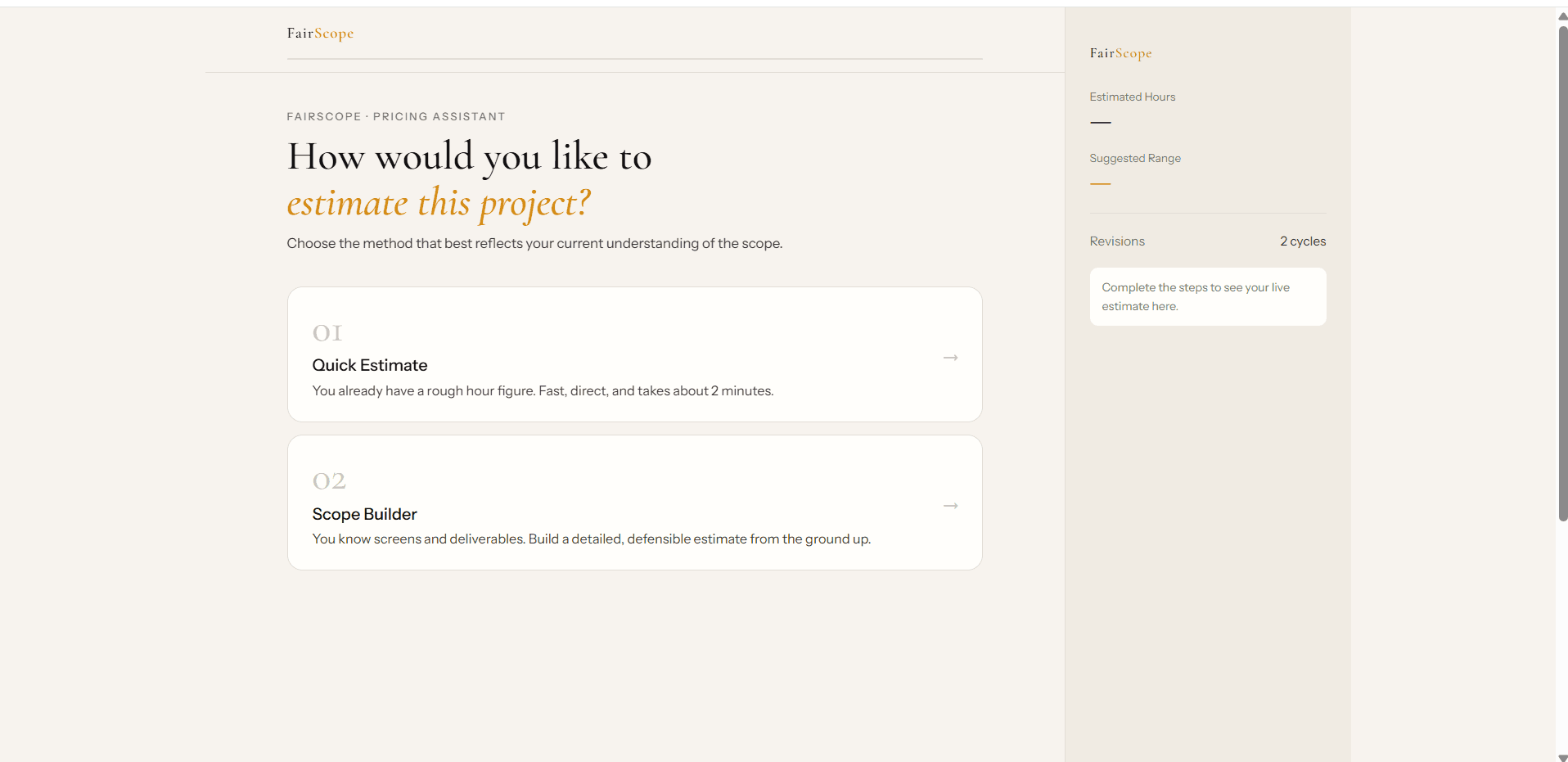
The tool had one job: make the invisible visible. Every hour spent in client calls, every revision cycle, every handoff document had to show up somewhere in the estimate. Not hidden, not bundled, but named and explained so a designer could point to it and say, this is why.
It also had to generate the words. Most designers know roughly what they want to charge. What stops them is the moment a client asks why. The tool had to hand them a ready answer.

Designing the Experience
The first version was a single page. Fill in the fields, see the number. It worked and felt completely wrong.
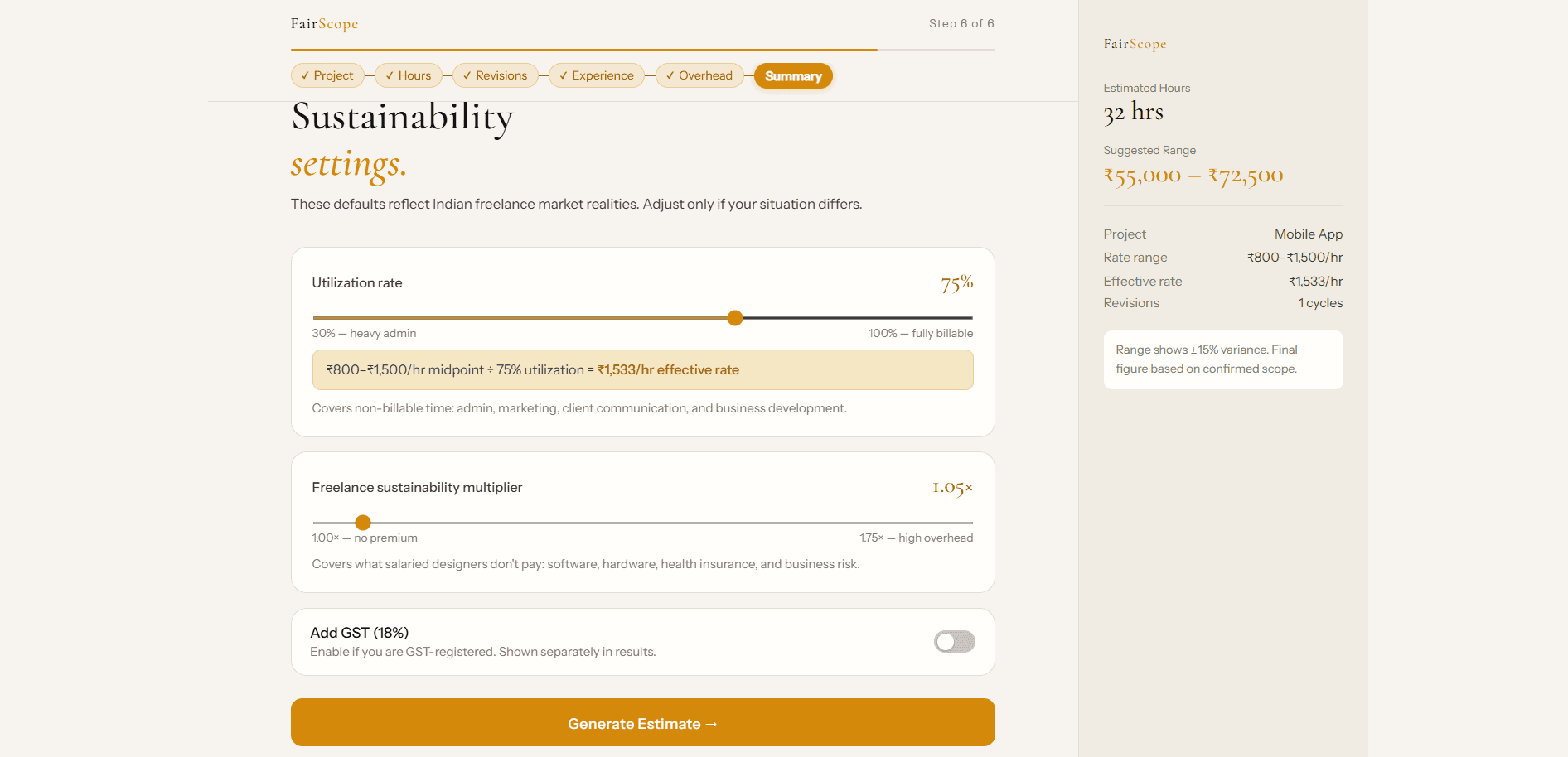
The problem was that a form you can see all at once is a form you rush through. I needed designers to actually stop and think at each decision. So I broke it into steps. One question per screen. A live estimate updating on the right as they answered. When someone had to explicitly choose how many revision cycles before they could continue, they were forced to treat revisions as real work, not an afterthought.
The visual direction followed the same logic. Warm off-white, deep charcoal, amber-gold. The palette of a financial instrument, not a startup. The price reveal gets forest green, a colour used nowhere else, so the moment the number appears it feels settled and final.

Building It with Claude
I am a designer. I had never shipped a production web application before this.
I started by describing what I wanted, not in wireframes or specs, but in plain conversation. The first working version came back in a single session. What followed over three weeks was less like using a tool and more like working with a collaborator who could implement whatever I could articulate clearly. Dark mode, a step-by-step roadmap, a transparent cost breakdown, client justification text generated from the actual inputs, all of it deployed as a live Next.js app on Vercel.
This is what vibe coding actually means. Not writing less code, but collapsing the distance between having an idea and having a product. The skill it demands is not syntax. It is knowing what good looks like well enough to ask for it precisely.
What I Learned
The most surprising thing was how much the structure of the tool changed the thinking of the person using it. Designers who walked through all ten steps came out the other side with a number they could actually defend, not because the tool was persuasive but because it had made them think through every piece.
Building it taught me something too. AI-assisted development only holds together if you stay the decision-maker. The pricing engine needed rebalancing three times because the early numbers were not grounded in how Indian freelancers actually work. The tool moved fast. The judgment still had to come from me.
FairScope exists because a real problem needed a real solution, and for the first time the gap between imagining something and shipping it was small enough to cross.
